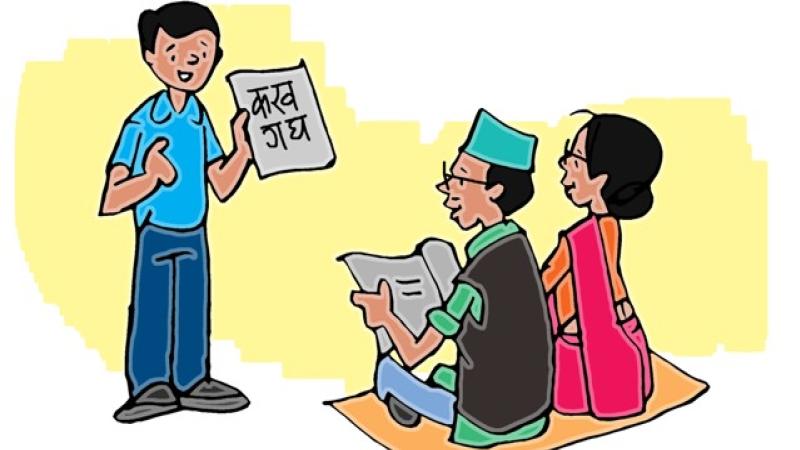
Mar 26, Kathmandu: The results of the national census clearly show that the results of investment in education have not been achieved. The details of the census released by the National Statistics Office have further confirmed this.
According to the census, the country's literacy rate is 76.2 percent. Although this data was released on Friday, it was collected last year. While the government made a written international commitment to eradicate illiteracy from the country in 2015 AD.
The Ministry of Education, Science, and Technology estimated that the literacy rate in this census will be more than 85 percent. The ministry said that a serious study will be conducted on why there was less than expected. Dr. Joint Secretary of the Ministry of Education, Science, and Technology. Hariprasad Lamsal said, "Sometimes, the methodology used in data collection may also produce different results. Is it still the same now? Anyway, we will review it.”
According to the 2068 census, Nepal's literacy rate was 65.9 percent. In 10 years of the campaign which was conducted by spending crores of rupees every year, there has been only 10 percent growth. According to the national census, 203.41 thousand 623 people out of a total of 26.66775975 people aged five and above can read and write.
The government started the Literacy Campaign as a campaign in 2009 AD. The campaign was then conducted intensively for six years. Even after that, this campaign is being carried out. According to government statistics, the state has spent about 10 billion rupees since 2065 till now on literacy in the age group of 15 to 60. Similarly, at least 70 percent of the state's annual budget is being invested in school education.
Academician Professor Dr. Bidyanath Koirala said that the campaign could not be successful as it was not clear who is responsible for making citizens literate. “This campaign was entrusted to the staff before the country moved to a federal structure. At that time, the government forgot the reality that employees are not people-oriented, so the results did not come as expected," Koirala said. The effect of which was seen in the results.”
According to the latest statistics, the literacy rate of men in the country is 83.6 percent and that of women is 69.4 percent. In the 2012 censuses, 75.1 percent of males and 57.4 percent of females were literate. Similarly, it has been found that 82.1 percent are literate in Bagmati province. Madhesh province has the lowest i.e. 63.5 percent. The literacy rate of men and women is also the lowest in Madhesh province compared to other provinces.
According to the census, Kathmandu district has the highest literacy rate of 89.23 percent and Rautahat district has the lowest literacy rate of 57.75 percent. Male and female literacy rates are also 94.19 percent and 84.16 percent respectively in Kathmandu compared to other districts. In Rautahat, it is 66.2 for men and 49.48 for women. Rautahat has the lowest male and female literacy rates?
The literacy rate of Lalitpur is 88.8 percent, Bhaktapur 87.96 percent, Kaski 87.73 percent, and Chitwan 83.68 percent. Similarly, Mahottari has 59.77 percent, Sarlahi 60.31 percent, Humla 63.84 percent, and Bara 64.54 percent.





 Indian Rupee
 U.S. Dollar
 European Euro
 UK Pound Sterling
 Swiss Franc
 Australian Dollar
 Canadian Dollar
 Singapore Dollar
 Japanese Yen
 Chinese Yuan
 Saudi Arabian Riyal
 Qatari Riyal
 Thai Baht
 UAE Dirham
 Malaysian Ringgit
 South Korean Won
 Swedish Kroner
 Danish Kroner
 Hong Kong Dollar
 Kuwaity Dinar
 Bahrain Dinar