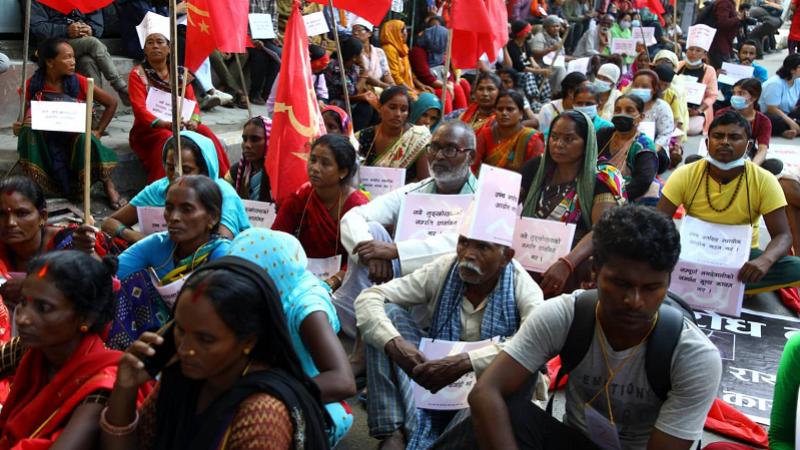
May 05, Kathmandu- Meter interest will be imprisoned for seven years and fined up to 70,000 rupees.
The government has amended the Civil Code 2074 through an ordinance to solve the meter interest problem and declared the act illegal.
By adding Section 249A to the Criminal Code 2074, the Ordinance has defined meter interest transactions as 'improper transactions' and declared them illegal for the first time.
Although the government formed an inquiry commission to solve the meter interest problem, since the current Nepalese law does not clearly define the act as a crime, President Ram Chandra Paudel issued an ordinance on May 3 on the recommendation of the cabinet.
With the promulgation of the Ordinance, the meter interest problem has been established as an illegal act as 'improper transaction'. Which has opened the way for the Commission of Inquiry to do its work. According to the agreement made by the government with the meter bagging victims, the investigation process has been started by preparing the legal basis through the ordinance.
The Ordinance considers the act of making a document that is not a transaction or having an amount that was not done, preparing a document that is more than the actual amount, adding interest to the principal, preparing a new document that doubles the interest to the principal as an offense of improper transaction.
Similarly, actions such as not paying back the amount paid or not making a document, charging more interest than the principal, threatening debt collection, using violence or exploitation, and transferring the immovable property rights of the debtor are considered unfair transactions.
The Ordinance has made a legal provision to cancel the transfer of immovable property rights due to meter-interest problem.
Those who are found guilty of the meter interest offense will be imprisoned for up to seven years and fined up to 70,000 rupees. Until now, there was confusion as to which law to prosecute in case of committing a crime related to meter interest.
The Ordinance amends the Civil Code, 2074, and stipulates that at least one witness must be kept from the creditor and the debtor while preparing the document of transaction.
The ordinance prohibits house-to-house transactions of more than one lakh. Section 488 of the Civil Code provides that legal remedies can be sought for non-receipts in transactions made through cheques, negotiable instruments, vouchers or ledger accounts.
The Ordinance has added a restrictive sentence in that section, providing that no legal remedy can be sought for transactions of more than one lakh. It has been said, "However, in the case of transactions of more than one lakh rupees, such amount will not be paid in cash or at home."
The ordinance stipulates that documents of transactions that are not registered in the ward should be registered within 6 months. When registering such documents, the ward will have to examine them.












 Indian Rupee
 U.S. Dollar
 European Euro
 UK Pound Sterling
 Swiss Franc
 Australian Dollar
 Canadian Dollar
 Singapore Dollar
 Japanese Yen
 Chinese Yuan
 Saudi Arabian Riyal
 Qatari Riyal
 Thai Baht
 UAE Dirham
 Malaysian Ringgit
 South Korean Won
 Swedish Kroner
 Danish Kroner
 Hong Kong Dollar
 Kuwaity Dinar
 Bahrain Dinar