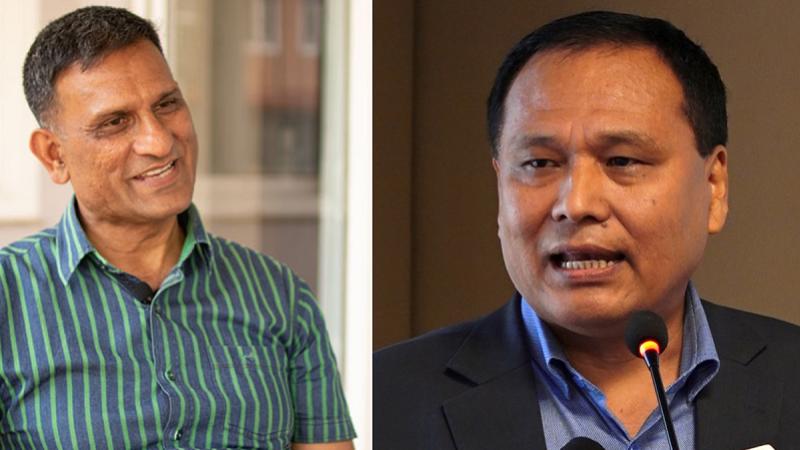
Aug 13, Kathmandu- Lately, former DIG Ramesh Kharel, who is known as a media person and social activist, has filed a complaint against the Executive Director of Nepal Electricity Authority (NEA), Kulman Ghising, in the Commission for the Investigation of Abuse of Authority.
Ghising filed a complaint with the Authority on Tuesday, alleging that he committed corruption while working as the Managing Director of the Electricity Authority for two terms.
Kharel claims that Kulman has done Power Purchase Agreement (PPA) of electricity causing loss of crores of rupees to the state.
Kharel has claimed that Kulman violated the law by signing PPA with 66 companies during his tenure. He also claimed that the state had a revenue loss of 11 million 726 thousand 520 rupees.
Kulman had entered into PPAs with various energy-producing companies on various dates in 2075 and 2076. He has claimed that the PPA with that company without the approval of the Electricity Regulatory Commission had to be deposited in the account of the Electricity Regulatory Commission.
The Electricity Regulatory Commission should charge a fee when agreeing to the power purchase agreement. "Only after receiving the said amount, the authority can do PPA. But the managing director of the authority has done PPA on his own in defiance of the law", Kharel said, "Even after one year of the commission act, the authority has done PPA without approval and has caused a loss of crores to the state. Even though the Electricity Regulation Act came into effect on 17th of Mangsir 2074, Kulman entered into PPA with 62 power producers in 2075 and 4 power producers in 2076. Even though the head of the authority has gone ahead with the violation of laws and regulations, the Ministry of Energy and the Electricity Regulation Commission established in 2076 have not been able to take concrete steps in this matter. There is no doubt that the graph of irregularity and corruption will continue to rise when the state agencies silently support such tendencies".












 Indian Rupee
 U.S. Dollar
 European Euro
 UK Pound Sterling
 Swiss Franc
 Australian Dollar
 Canadian Dollar
 Singapore Dollar
 Japanese Yen
 Chinese Yuan
 Saudi Arabian Riyal
 Qatari Riyal
 Thai Baht
 UAE Dirham
 Malaysian Ringgit
 South Korean Won
 Swedish Kroner
 Danish Kroner
 Hong Kong Dollar
 Kuwaity Dinar
 Bahrain Dinar