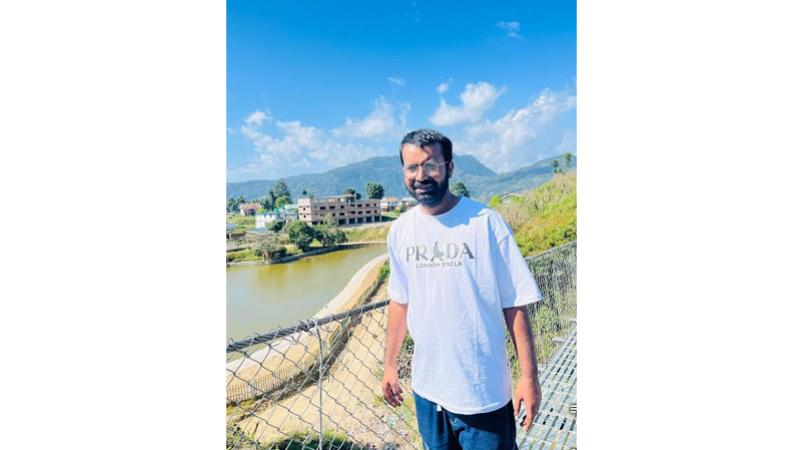
Author: Arjun Dahal
Dec 07, Kathmandu - We shall begin our analysis with two questions that are of great importance. One is “Who discovered America?” The answer is known by most Nepalese as Christopher Columbus, and the second question is “Who discovered India?”, and like the earlier question, it’s answer is known by most Nepalese as Vasco de Gama. These two questions are asked and taught to students from their early childhood till they attempt their service commission examination to secure a permanent job. If we analyse these two questions, then we can easily find that these two questions were meant to be taught at European schools, and probably were taught too during the earlier centuries that passed. I am not well aware of America, but like Nepal, even India had the culture of Vedanta, the school derived from 'Vedas' to mark their significance and existence even before the times of Columbus or Vasco de Gama. Thus these two questions are the points of our argument to discuss why European and Western thoughts are dominant in our society as well as whole nation along with their impacts, necessities, and counter-cultural values because I believe Vasco de Gama is still being taught in India, irrespective of Grukulas or the necessity to discuss their existence before the time it was formally claimed to be discovered. It is an undeniable fact that the Europeans, as well as Americans, have progressed a lot in every human need, and we shall see why their thoughts are dominant.
Nepal is a country that is rich in culture. Culture plays as an essential backbone of the societal aspects and the bonding in society. Humans, like the rest of the species, are social animals. Thus, we have to begin to imitate Western culture. This is not a bad trend until and unless we are able to save our so-called indigenous cultural aspects. Culture is directly linked to livelihood, thus it plays a key role. Regarding the developments of science, technology, or any sector, we are still following the Western nations to find suitable aspects that can address our nation. Being specific, we have nothing to argue against the western nations where we can consider ourselves better, even though we had both the scripted and unscripted learning system derived from the Vedas and Puranas as a part of theology and philosophy.
Now we shall come to the point to find out why Europeans and Westerners progressed so far, whereas we failed. The first thing relies on freedom, and the second thing relies on their freedom to speech. The western society speaks of their mind irrespective of any shyness or hesitations, which have taken the form of roots of their livelihood. For them their interest and ability is of great importance thus they have succeeded in arts, music, literature, science, technology, developments, literature, and literally in every aspect of human life.
Now we shall revisit our second and third paragraphs. We still believe in the Vedas, Upanishads, and Puranas, that serve as a theological and philosophical narrative of divine persons or scholars. We have our own art, music, science, technology, academic system, system of graduation from gurus, and everything that we are still learning from Western society. Then a question arises, “Why did we fail?” and the simple answer lies in the lack of freedom and the lack of development in our ancient scripts. The westerners knew angels could fly, and we, too know the angels in our scriptures too can fly. The westerners inquired how the angels flew and invented aeroplanes and other flying machines, whereas we thought it was a sin to inquire on how angels flew. Thus, we did recite the verses in Vthe edas and Puranas from top to bottom and seldom inquired, and we never sought the need of flying machine for our convenience. We seldom inquired how angels flew from the heavens to earth. We shall again revisit our third paragraph, where we concluded that western peoples have freedom and they speak their mind. Our Nepalese society too, is progressing towards those aspects, but we haven’t achieved that. We praise the westerners regarding how free they are, then we try to imitate and implement it in our society, forgetting that society is a group of individuals, not a single individual. This then leads towards despair. With the advent of the internet, we are progressing rapidly, in fact exponentially, towards freedom, but we still lack ethical values. We praise the society, their ethics, administration, government, their judgment and every aspect of Westerners, and this is what creates their dominance. They speak and demonstrate the things that we fail to speak either it be injustice, socialism, digital wellbeing, corruption or any matter of public opinion. This leaves their impression upon us, which we try to imitate. I don’t mean that we should be reading the Vedas and Upanishads all the time; however, I mean that there is no harm in reading them in our leisure time (though we are told that they would harm), and a rebellion is needed. Even the Western society has gone against a lot of biblical norms and they have progressed towards a more humanistic view of society that can be achieved with freedom of living. Freedom is scripted even in the Vedas and Upanishads, ethics is implanted there too, but we have failed to speak our own mind, and thus we praise those who speak for us or speak our mind. This then clearly leads us to find why we are studying Columbus and Vasco de Gama in our textbooks as an impact of Western culture as well as their celebrated discovery. Maintaining counter-culture is our present need, which would boost our knowledge as well as preserve our roots. The impact is due to freedom, mutual understanding and ethics, which has resulted in luxury for them as seen by us, and their happiness and progress are what we are trying to imitate as an impact by even trying to migrate Western nations. We haven’t discussed impacts in arts, music, literature, science, or culture in this article because they are seen in our society by all, but have been emphasized on freedom, exploration, and a quest towards knowledge to conclude that even during the presence of gurukulas, the entire indian subcontinent read about Vasco de Gama.















 Indian Rupee
 U.S. Dollar
 European Euro
 UK Pound Sterling
 Swiss Franc
 Australian Dollar
 Canadian Dollar
 Singapore Dollar
 Japanese Yen
 Chinese Yuan
 Saudi Arabian Riyal
 Qatari Riyal
 Thai Baht
 UAE Dirham
 Malaysian Ringgit
 South Korean Won
 Swedish Kroner
 Danish Kroner
 Hong Kong Dollar
 Kuwaity Dinar
 Bahrain Dinar