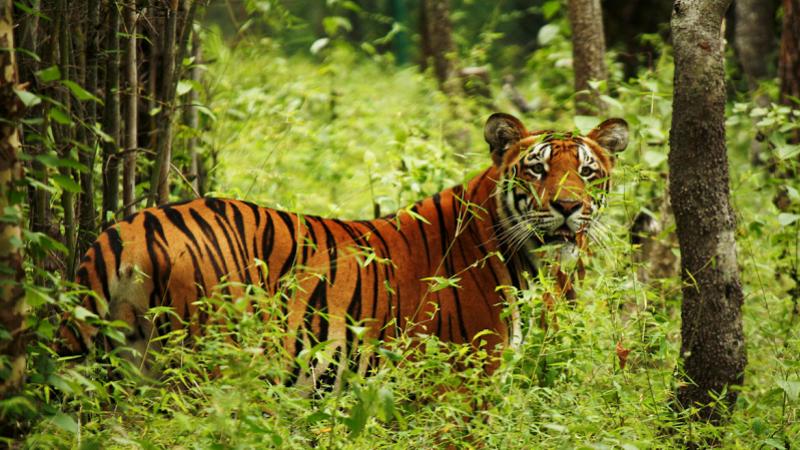
Jan 04, Kathmandu - The tiger census that began on Paush 30 is continuing in Chitwan National Park. The census is being conducted in a block of Chitwan and Parsa National Parks, and the first part of the census has been completed.
According to Avinash Thapa Magar, the park's information officer, the work of raising the cameras has begun after completing the first part of the census. He said, "The work of raising the cameras has started from Saturday. The work of raising the cameras of the first part will be completed by Monday." According to him, 150 enumerators who were trained on Paush 1 and 2 have been deployed for the census.
Information Officer Magar informed that the Barandabhar area has been counted in the first part through Triveni, Amaltari, and Kasara. According to him, 286 grids have been made in this area under the first part and the count has been started. After the cameras are lifted, the count will be started by installing cameras in the second part.
Information Officer Magar of the park said that 13 camps will be set up and enumerators will be deployed in the second part. Under this part, the count will be done by installing cameras in the area through Sauraha, Khagendramalli, Lothar Pratappur, Hudi, Bote Simara, Swameshwor, Bagai, Ambuwa and Sikaribas.
“The tiger count will be done by dividing that area into 336 grids,” he said, “A pair of automatic cameras will be placed in each grid.” According to Thapa, the tiger count will be done by placing cameras in each area for two weeks.
The tiger count is being done by making 958 grids in the Chitwan-Parsa block. This means that a two-square-kilometer area is being counted by making one grid. Similarly, tiger count is being done in Banke, Bardiya and Shuklaphanta National Parks, which have tigers.
Information Officer Magar mentioned that the tiger census is going to be conducted in three months. Tiger census is being conducted every four years. Park employees, technicians from the National Trust for Nature Conservation, local volunteers, students and conservation partners have participated in the census. He informed that a technical camp for the census is being set up in the middle of the grids.
The enumerators will monitor the cameras placed in the grids from eight to twelve according to geography on a daily basis, Information Officer Magar informed. “The study will begin after the cameras are removed from the grid. During the tiger census, automatic cameras will be placed in places where tigers move around more. These cameras will take photos of the tigers,” he said.
He said that the number will be allocated based on the parts on the body of the tigers by looking at their photos. According to him, each tiger has different parts.
“The first complex (area) is this, while the second complex has been made up of Banke and Bardiya National Parks. There will be three blocks within it. The third complex will be Shuklaphanta National Park and Laljhandi. This will be made up of a single block,” he said.
Earlier, in the 2022 tiger census, data was made public that there were 355 adult tigers in Nepal. In that census, 128 tigers were found in Chitwan, 125 in Bardiya Park, 25 in Banke Park, 41 in Parsa and 36 in Shuklaphanta.










 Indian Rupee
 U.S. Dollar
 European Euro
 UK Pound Sterling
 Swiss Franc
 Australian Dollar
 Canadian Dollar
 Singapore Dollar
 Japanese Yen
 Chinese Yuan
 Saudi Arabian Riyal
 Qatari Riyal
 Thai Baht
 UAE Dirham
 Malaysian Ringgit
 South Korean Won
 Swedish Kroner
 Danish Kroner
 Hong Kong Dollar
 Kuwaity Dinar
 Bahrain Dinar