Jan 27, Kathmandu - The European Union (EU) and India have announced a historic trade deal after nearly two decades of ups and downs in negotiations. The deal aims to further strengthen ties between the two sides, against the backdrop of strained relations with the United States.
European Commission President Ursula von der Leyen wrote on social media, “Today, Europe and India have made history. We have concluded the biggest deal ever.”
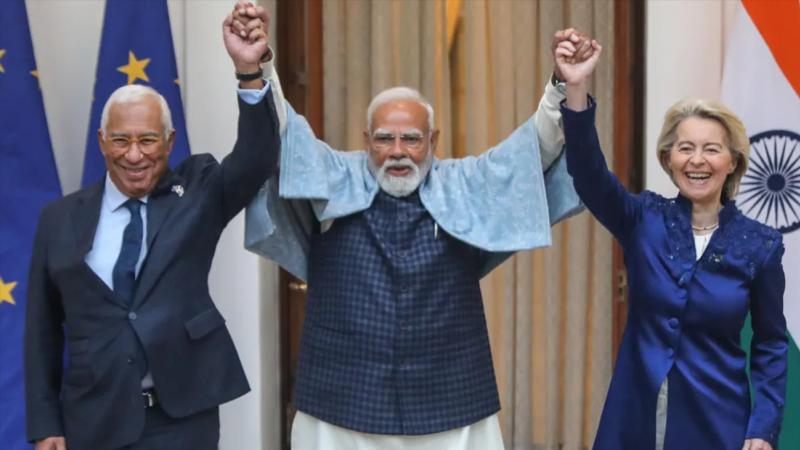
von der Leyen and European Council President Antonio Costa are currently in Delhi. They met Indian Prime Minister Narendra Modi during a bilateral summit.
Both India and the EU are trying to strengthen strategic and trade ties with the rest of the world as they face growing economic and geopolitical pressure from the US.
India is facing a 50 percent tariff imposed by President Donald Trump last year. Negotiations for an India-US trade deal are still ongoing.
Last week, Trump threatened to escalate a trade war with a European ally that opposed US control of Greenland, although he backed down.
This broader geopolitical backdrop is reflected in recent statements by leaders.
On Tuesday, von der Leyen wrote, “We have created a free trade area covering two billion people, from which both sides will benefit. This is just the beginning. We will further strengthen our strategic relationship.”
A day earlier, Costa, without naming the US, had said, “This trade agreement will send an important political message to the world, that India and the EU believe in trade agreements more than tariffs.”
Further details of the agreement are expected to be released in a media briefing soon.
von der Leyen and Costa arrived in Delhi last weekend and were the chief guests at India’s grand Republic Day celebrations on Monday.
On Tuesday, they posed for a photo with Prime Minister Modi, in a clear display of cordiality.
The formal signing of the agreement will only take place after it is approved by the European Parliament and the European Council, likely by the end of this year.
The agreement will expand market access for Indian exports to Europe and facilitate European investment and goods such as cars and beverages to enter Asia's third-largest economy.
Prime Minister Modi, while inaugurating the 'India Energy Week' conference on Tuesday, said, "This is a great example of a partnership between the world's two largest economies. This agreement covers 25 percent of the world's gross domestic product (GDP) and a third of world trade."
The EU is India's largest trading partner in goods. In 2024-25, goods trade between the two sides reached $136 billion, almost doubling in a decade.
Negotiations for an India-EU trade agreement began in 2007. But the talks were stalled in 2013 due to obstacles related to market access and regulatory demands. The talks were formally resumed in July 2022.
The main points of contention are access to India’s automobile market, agricultural goods and carbon-related tariffs. Analysts will be keen to see how these issues are addressed in the final agreement.
Officials on both sides have been working hard in recent days to finalise the remaining chapters of the deal ahead of the EU leaders’ visit. The deal comes as pressure is mounting for exporters to find alternative markets.
In the past seven months, India has signed major trade deals with Britain, Oman and New Zealand. It also has a deal with the four-nation European Free Trade Association, which includes Switzerland, Norway, Iceland and Liechtenstein, which will come into force in 2024.
Meanwhile, the EU earlier this month struck a trade deal with the South American trading bloc Mercosur after 25 years of negotiations.










 Indian Rupee
 U.S. Dollar
 European Euro
 UK Pound Sterling
 Swiss Franc
 Australian Dollar
 Canadian Dollar
 Singapore Dollar
 Japanese Yen
 Chinese Yuan
 Saudi Arabian Riyal
 Qatari Riyal
 Thai Baht
 UAE Dirham
 Malaysian Ringgit
 South Korean Won
 Swedish Kroner
 Danish Kroner
 Hong Kong Dollar
 Kuwaity Dinar
 Bahrain Dinar