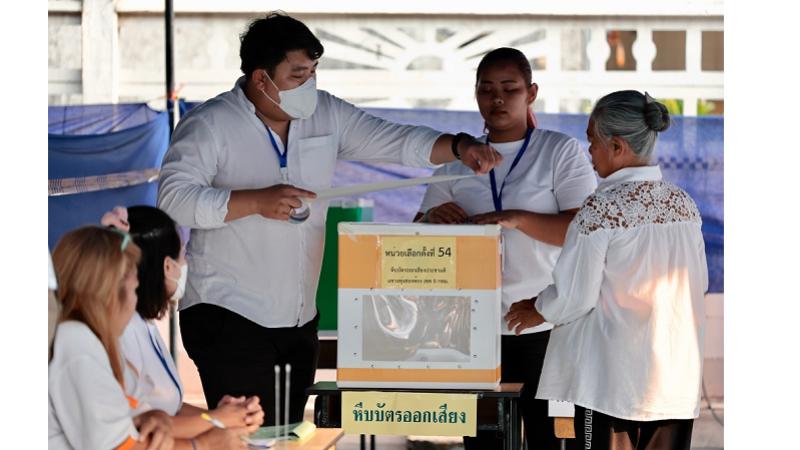
Feb 08, Kathmandu - Thailand conducted its general election on Sunday, marking a crucial step in its democratic process. Around 53 million registered voters participated in a fiercely contested race among pro-progressive, populist, and traditional conservative parties.
Despite the presence of over fifty parties in the electoral race, the main contenders are the Popular Party, Bhumjaithai, and Pheu Thai, all of which boast widespread national support and organizational strength. The election results will determine which party or coalition secures a simple majority in the 500-member House of Representatives, paving the way for the next prime minister.
Pre-election polls suggest a fragmented landscape, with no single party likely to achieve an outright majority, indicating that coalition governments will be inevitable. While the progressive Popular Party is seen as a frontrunner to become the largest party, analysts warn that disagreements over its reformist agenda could pose challenges in forming a stable government.
The Popular Party, led by Nattawut Saikua, emerged victorious in 2023 but was prevented from forming a government. It is the successor to the Move Forward Party, which has pledged reforms in the military, police, and judiciary. However, facing legal pressures, the party has retreated from pushing for constitutional amendments related to the monarchy, prioritizing economic issues instead.
Currently, Prime Minister Prayut Chan-o-cha's Bhumjaithai Party is viewed as closely aligned with the royal-military establishment. Capitalizing on rising nationalist sentiments following border clashes with Cambodia, Prayut has focused his campaign on national security and economic incentives.
Meanwhile, the Pheu Thai party, rooted in the legacy of former Prime Minister Thaksin Shinawatra, is rallying support through populist promises such as economic revival and cash transfers. Thaksin's nephew, Paetongtarn Shinawatra, is emerging as a leading contender for the prime ministership.
The election also initiates a referendum on whether to replace Thailand’s 2017 military-drafted constitution. This constitutional overhaul aims to transfer parliamentary authority to draft a new constitution, a move seen by pro-democracy groups as a step to curtail the influence of unelected institutions. Conversely, conservative factions warn that such changes could trigger political instability.
As Thailand navigates this pivotal electoral process, the nation stands at a crossroads between democratic reform and conservative stability.















 Indian Rupee
 U.S. Dollar
 European Euro
 UK Pound Sterling
 Swiss Franc
 Australian Dollar
 Canadian Dollar
 Singapore Dollar
 Japanese Yen
 Chinese Yuan
 Saudi Arabian Riyal
 Qatari Riyal
 Thai Baht
 UAE Dirham
 Malaysian Ringgit
 South Korean Won
 Swedish Kroner
 Danish Kroner
 Hong Kong Dollar
 Kuwaity Dinar
 Bahrain Dinar