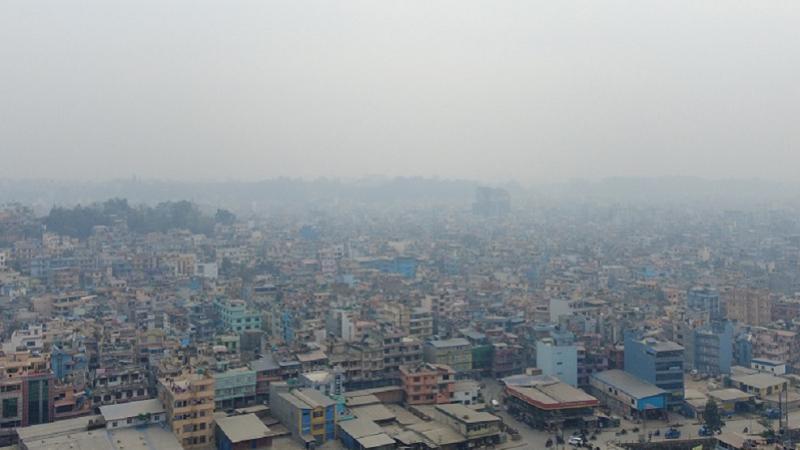
Feb 17, Kathmandu - Kathmandu Valley has experienced a significant rise in air pollution levels. As of Monday noon, the Air Quality Index (AQI) was recorded at 178, and by midday today, it has increased to 191. This level falls within the 'Unhealthy for All' category, which can particularly impact children, the elderly, and individuals with respiratory and heart conditions.
According to the latest data, the air pollution in Kathmandu Valley has reached an unhealthy level. The AQI has ranked Kathmandu as the third most polluted city in the world. India’s Delhi ranks first with an AQI of 229, followed by Lahore, Pakistan, with an AQI of 203.
Gyanraj Subedi, Director General of the Department of Environment, warned that if there is no rainfall in the coming days, pollution levels could worsen further. Rain helps settle dust and particles suspended in the air, but prolonged dry weather can lead to higher pollution concentrations. He emphasized the need for effective implementation of sustainable and environmentally friendly development measures and advised relevant authorities to take action.
Environmental activist Varsha Parajuli attributed the rising pollution to rapid vehicle growth, emissions from diesel and petrol vehicles, dust from ongoing road and infrastructure projects, forest fires, and extended dry weather conditions.
“If measures are not taken promptly, the situation could become more complicated,” she warned. Parajuli also urged for timely awareness and precautions, noting that in the AQI index, values from 0 to 50 are considered good (green zone), 51 to 100 are cautionary (yellow zone), 101 to 150 are unhealthy for sensitive groups, 151 to 200 are unhealthy for all, 201 to 300 are very unhealthy, and above 300 are extremely dangerous.
According to the Kathmandu Valley Air Quality Management Plan 2076 (Nepali calendar), the government considers AQI levels exceeding 300 as a disaster. To reduce such hazards, measures include stopping burning illegal waste, increasing the use of street sweepers and vacuum cleaners for road cleaning, and issuing public advisories to protect children, the elderly, and patients.
The National Environmental Policy 2076 emphasizes the development and implementation of national standards for reducing air, water, soil, noise, electromagnetic radiation, radioactive pollution, and hazardous chemicals. It also plans to establish pollution monitoring centers in major cities, industrial areas, and high-risk zones to map air, water, and noise quality.












 Indian Rupee
 U.S. Dollar
 European Euro
 UK Pound Sterling
 Swiss Franc
 Australian Dollar
 Canadian Dollar
 Singapore Dollar
 Japanese Yen
 Chinese Yuan
 Saudi Arabian Riyal
 Qatari Riyal
 Thai Baht
 UAE Dirham
 Malaysian Ringgit
 South Korean Won
 Swedish Kroner
 Danish Kroner
 Hong Kong Dollar
 Kuwaity Dinar
 Bahrain Dinar