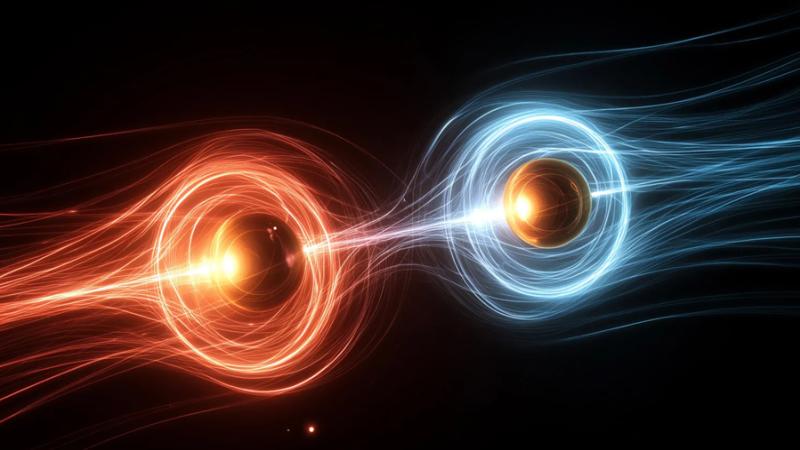
Apr 25, Kathmandu - Scientists have achieved a major milestone in understanding the universe's fundamental workings by harnessing artificial intelligence (AI) to uncover new laws hidden within nature.
Researchers from Emory University have developed a specially designed neural network that combines ultra-precise 3D tracking of particles within dusty plasma, revealing complex interaction patterns previously beyond reach.
Plasma, often called the fourth state of matter, exists throughout space and within Earth's fiery atmosphere. Remarkably, this study not only analyzed data but also challenged long-standing physics theories, unveiling new truths about this mysterious state.
Plasma forms when gases ionize, allowing electrons and ions to move freely, exhibiting unique properties like electrical conductivity. Nearly 99.9% of the observable universe is composed of plasma. Dusty plasma, a variant, includes tiny dust particles alongside ions, found from Saturn’s rings to Earth’s ionosphere.
In controlled laboratory experiments, scientists used lasers and high-speed cameras inside vacuum chambers to record particle movements with extraordinary precision. Feeding this data into their AI model, they achieved over 99% accuracy in explaining non-reciprocal forces—interactions where particles influence each other differently depending on the direction.
These non-reciprocal forces are notoriously complex. Imagine two boats passing each other; the front boat creates waves pulling the second forward, while the second pushes back. Similarly, in dusty plasma, particles attract in one direction and repel in another, creating unusual behaviors. Previous theories simplified the relationship between a particle's charge and size, but AI revealed that plasma density and temperature intricately influence these forces.
Importantly, this AI approach isn’t a “black box.” It breaks down particle movements into three main effects—velocity-related obstacles, environmental forces like gravity, and mutual interactions—making the findings accessible and understandable.
Beyond physics, this methodology has potential in bioengineering and biology. It could help explain how cancer cells spread or how animals and humans develop collective behaviors in groups.
Ultimately, this research establishes AI not just as a tool but as a partner in discovering nature’s hidden rules—opening new frontiers in understanding the universe.















 Indian Rupee
 U.S. Dollar
 European Euro
 UK Pound Sterling
 Swiss Franc
 Australian Dollar
 Canadian Dollar
 Singapore Dollar
 Japanese Yen
 Chinese Yuan
 Saudi Arabian Riyal
 Qatari Riyal
 Thai Baht
 UAE Dirham
 Malaysian Ringgit
 South Korean Won
 Swedish Kroner
 Danish Kroner
 Hong Kong Dollar
 Kuwaity Dinar
 Bahrain Dinar