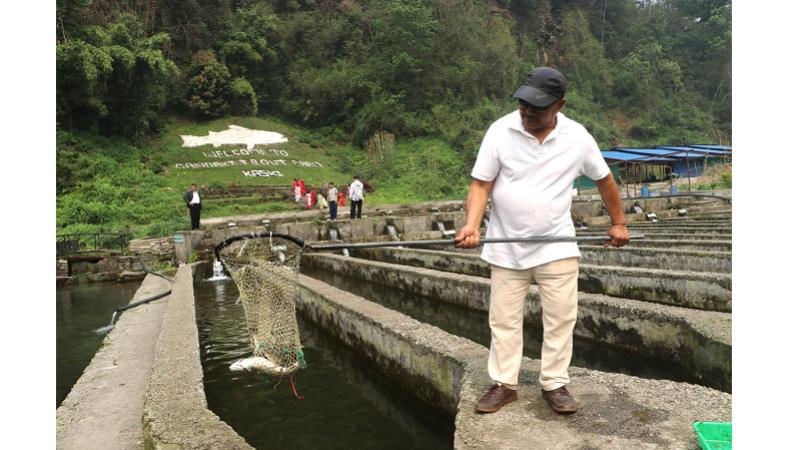
May 19, Kathmandu - Once a muddy, overgrown area filled with weeds in Bhurjung Khola, Ward 3 of Machhapuchhre Rural Municipality, Gandaki Trout Farm has transformed into a thriving tourist destination and economic hub. The site, once struggling with rice cultivation and dense vegetation, now attracts visitors eager to taste fresh trout and enjoy nature’s beauty.
The farm was initiated in 2067 BS by two brothers who returned to Nepal after serving in Japan and the UK, driven by a message: “Learn skills abroad, return home, and uplift the nation.” Amrit Gurung, a retired Indian Army soldier who lived in Japan, and Lachhin Gurung, who left Hong Kong and the UK’s business scene, founded Ghandaki Trout Farm with the vision of utilizing their international experience for local development.
Their shared goal was to leverage their skills and knowledge to develop a new business in their homeland. They identified a cold-water spring in Ghandaki-3, where the temperature remains between 16°C and 18°C, as ideal for trout farming. They purchased 22 ropanis of land and began their venture, initially with two ponds. Today, the farm has expanded to 60 ponds, making it a success story in the Gandaki region.
This pioneering trout farm, the first of its kind in the area, has become a model for aspiring entrepreneurs and a source of inspiration for youth seeking opportunities abroad. The farm’s trout are rich in Omega-3 fatty acids, easy to eat due to their soft bones, and highly beneficial for health, making them popular among both domestic and international tourists.
Currently, the farm receives over 400 visitors daily, with numbers exceeding 1,500 on Saturdays. Visitors can enjoy freshly cooked trout at Rs. 1,700 per kilogram, along with comfortable cottages and arrangements for overnight stays. The farm produces around 25 tons of fish annually, worth approximately Rs. 30 million, and has invested over Rs. 70 million into its development. It employs 24 full-time and 10 part-time workers.
Due to high demand, the farm sources fish from nearby farms as well. Additionally, an investment of Rs. 2.5 million has led to the construction of a hatchery for trout breeding. Amrit Gurung, now 65, emphasizes that family support and cooperation from government and domestic and international organizations have been crucial to the farm’s success.
Gurung believes that attracting just two percent of the tourists visiting Pokhara can significantly extend their stay and generate more employment. The farm is accessible via a 17-kilometer route from Old Pokhara Market, passing through Mahendra Pul, Nadipur, Bagar, Lamachaur Akala, and Puranchaur.
More than a business, the farm has become a center of self-reliance and inspiration. Visitors can also enjoy traditional games like Linge, Charpirkhe Ping, and Paudi Pokhari, and share their experiences on social media, further boosting the farm’s popularity.





 Indian Rupee
 U.S. Dollar
 European Euro
 UK Pound Sterling
 Swiss Franc
 Australian Dollar
 Canadian Dollar
 Singapore Dollar
 Japanese Yen
 Chinese Yuan
 Saudi Arabian Riyal
 Qatari Riyal
 Thai Baht
 UAE Dirham
 Malaysian Ringgit
 South Korean Won
 Swedish Kroner
 Danish Kroner
 Hong Kong Dollar
 Kuwaity Dinar
 Bahrain Dinar