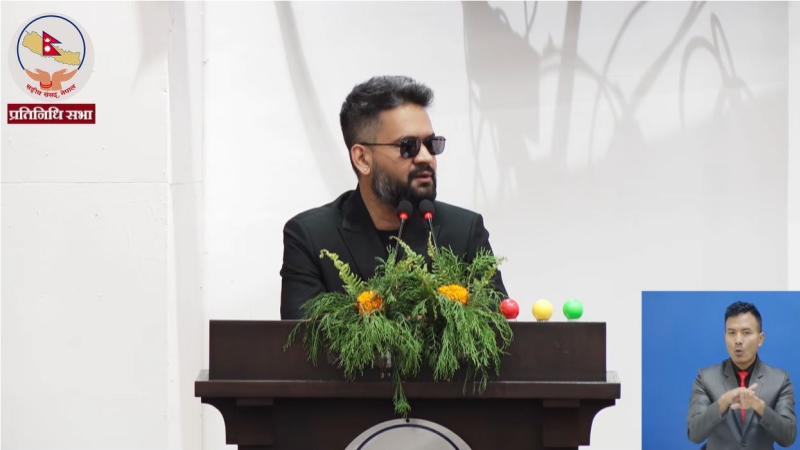
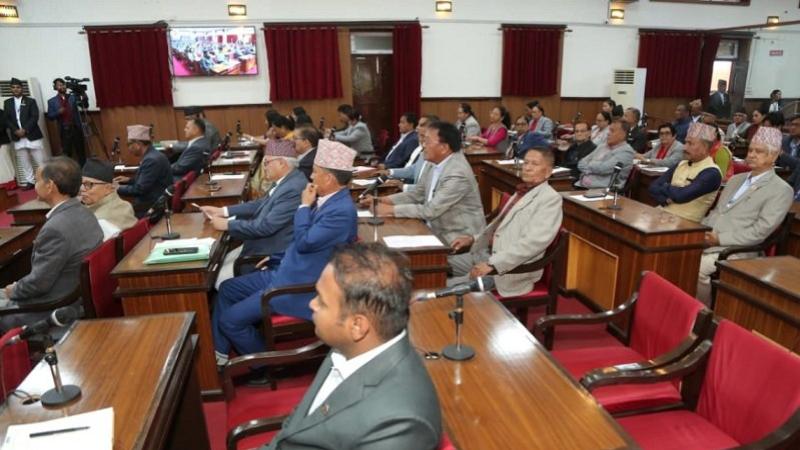
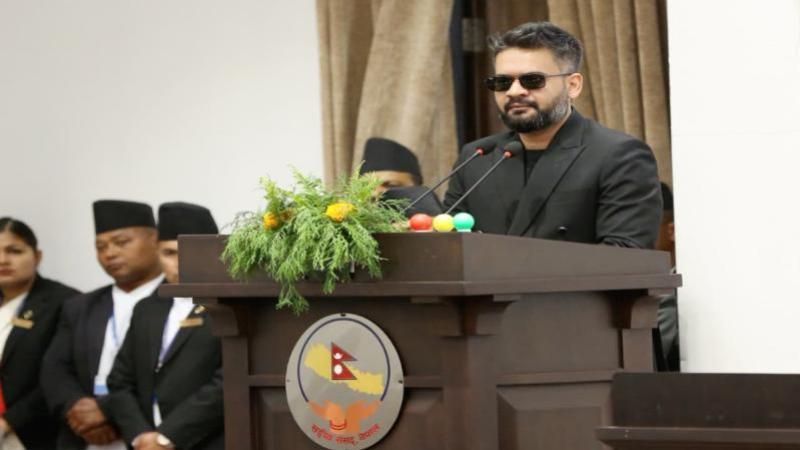
May 31, Kathmandu - Prime Minister Balen Shah appeared in the House of Representatives on Sunday to answer questions from lawmakers. When Balen said he would answer the questions, the opposition party raised questions that it could not be done according to the rules, but in the end, the question was asked and the Prime Minister answered. In the question-and-answer session, 7 lawmakers, including 6 parties and 1 independent, asked questions. Here is the Q&A with the Prime Minister in Parliament:
1. Nepali Congress MP Arjun Narsingh KC
Question: Honorable Prime Minister has stood up and asked for time for question and answer; this is a good aspect of the democratic process. My question – Why has the report of Gauri Bahadur Karki after the Gen-Z movement of 23-24 Bhadra not been officially published yet? The members of Parliament should get that report. I request the Prime Minister to form an impartial commission to investigate the destructive incident that took place in the country on the 24th. Also, when will the report submitted by the Human Rights Commission be made public, and when will action be taken against the guilty? In a legal state, there should be 'rule of law', not 'rule by law'.
Answer: I have taken what the honorable member said as advice and suggestion. Not only the report of the Human Rights Commission, but there are reports of many movements and incidents of repression that have taken place in different periods. The government will study all the reports of the commission that have been submitted to the Government of Nepal so far and take necessary action accordingly.
2. Padma Aryal, MP from CPN-UML
Question: The sovereignty and integrity of our nation are dearer to us than our lives. The map that includes Lipulekh, Limpiyadhura and Kalapani has been released. However, what is the Nepal government's view on the bilateral understanding between India and China that is being built on a trade route, leaving Nepal out? What is the government doing?
Answer: The Nepal government has officially sent a 'diplomatic note' to the Indian government on the issue of Lipulekh and Limpiyadhura, and a response has also been received. Both governments have agreed to resolve this through 'table talk' by having their historians and surveyors present. Since the problem of British India's withdrawal still exists, we have also talked to the English government on this. This can be resolved through diplomatic means.
3. MP Pramesh Hamal from the NCP
Question: We were in a position to be upgraded from a least developed country, which would have increased our national prestige. But it has been postponed for 2 years, saying that it will facilitate the export of some goods. Were we not ready for the upgrade this year? Prime Minister, you are sensitive to the poor, but the method adopted in managing squatters is not right. The current budget has also not been able to be lower-middle-class and poor-oriented. What is your opinion on this?
Answer: Let me give the example of neighboring country, China. China has just moved from 'developing' to 'developed'. This is a strategic issue. We are now getting exemption from taxes on exported goods when we 'graduate' from LDC. Now, rather than increasing our confidence, we need to increase money and exports in the country, which is why it has been postponed for 2 years. As far as the poor are concerned, in Kathmandu, we have strictly implemented 10 percent scholarships and 10 percent beds in hospitals for the poor. We are clear that the truly poor should receive free education and healthcare.
4. MP Aaren Rai from the Shram Sanskriti Party
Question: When will the problem of squatters and unorganized settlements be solved? Does this only happen on social media or is it also seen in practice? Second question, there has been a big scam in cooperatives in Nepal, when will the fraudsters including GB Rai be arrested? When will the victims get money? And, when will the border citizens feel that there is a government in the problem of Kalapani and Lipulekh? Also, I had given it to the Prime Minister in writing - when will the monkey management be done? This is not a laughing matter, it is a serious issue for farmers.
Answer: In the case of squatters, work is being done to shift those who are living precariously on the banks of the rivers of the Kathmandu Valley to holding centers. Those who are real squatters, the government will manage their land. Work that has not been done in 35 years cannot be done in 35 minutes, it takes some time. A fund has been set up in the case of cooperatives. According to last week's report, about 30 million rupees have been raised and 50-60 million have been distributed to the victims. This is not government money distributed, it was collected from the cooperative and given to the victims.
About monkeys and the report: A study committee will be formed for the reports. It has been heard that the Human Rights Commission report is 10,000 pages long, and it will be made public as soon as it is officially released. Mahavir Pun had also said about monkeys, that this is a very difficult issue. Fencing the fields is expensive. A committee has been formed to find out what the alternatives are without killing and violence, and the government will act after its study report comes out.
5. MP Khushbu Oli from the Rastriya Prajatantra Party
Question: Nepalese are being taken to Gulf countries in the name of visit visas for labor exploitation and human trafficking. What is the government's concrete plan to stop this? What do you think about the ban on domestic labor in foreign employment? Another thing, it is said to use electric stoves and scooters, but why is the middle class being hit by adding 5 percent VAT on electricity? It is said that increasing energy consumption has a positive impact on the economy, but why has the government made it more expensive?
Answer: Strict instructions have been given to airports and ministries to prevent misuse of visit visas. The Ministry of Labor is working on an alternative way to convert visit visas to 'working visas' if you get a job there. In the case of electricity, we are not in a position to immediately move to a fully electric era. If everyone turns on induction at once, transformers and sub-stations will not be able to cope; they will explode. 5 percent VAT above 50 units means only 5 rupees for 100 rupees. This money will be used to upgrade transformers and strengthen transmission lines, and only then can we truly move into the electric age.
6. MP Mahabir Pun
Question: I have been saying since I was a minister in the electoral government – when will there be a system to allow about 3 million Nepalis living abroad to vote? Another thing, the Comptroller General's Office has installed a software called 'Sutra' to collect revenue at the local level. There have been many complaints about it, sometimes the server goes down, sometimes it breaks down, so people are unable to get the service. Is this really broken or is it something else? When will it be resolved?
Answer: There are two options regarding allowing Nepalis living abroad to vote – whether to go to the embassy or vote from their mobile phones. There is a fear that voting from their mobile phones may be affected. The government is discussing technology to vote freely and securely. As far as the 'Sutra' software is concerned, I instruct the IT Minister to immediately manage this.
7. MP Kabindra Burlakoti from the Rastriya Swatantra Party
Question: Honorable Speaker, first of all, I would like to express my gratitude and respect to the Prime Minister for being present in the House for the question and answer session. In the recent elections, the common people have sent us to do the work of the citizens by giving a wonderful public vote. From the perspective of good governance, until some time ago, there was a situation where 'nothing gets done without bribery'. Bribery was almost mandatory in transfers and promotions. But after the formation of the government under your leadership, this old saying has been widely rejected. There is no doubt that this public vote of the common people is for good governance and prosperity. 'No if, no but', we need good governance and prosperity. I sincerely request the Prime Minister to make it clear to the common people that the government is working accordingly.
Answer: Our ministers and the party president have also been saying this issue. We have taken this first year as the 'Year of Good Governance'. By saying good governance, we do not mean stopping development and infrastructure. Under the supervision of our ministers, parliamentarians and various municipalities, work is being done to eliminate corruption and disorder. The roots of corruption are very strong, and the Government of Nepal and the National Independent Party are very keen to eradicate it. Citizens have now started feeling the change when they go to places like the Land Revenue Office, Company Registrar, and Blue Book Renewal. The government will continue this.




 Indian Rupee
 U.S. Dollar
 European Euro
 UK Pound Sterling
 Swiss Franc
 Australian Dollar
 Canadian Dollar
 Singapore Dollar
 Japanese Yen
 Chinese Yuan
 Saudi Arabian Riyal
 Qatari Riyal
 Thai Baht
 UAE Dirham
 Malaysian Ringgit
 South Korean Won
 Swedish Kroner
 Danish Kroner
 Hong Kong Dollar
 Kuwaity Dinar
 Bahrain Dinar