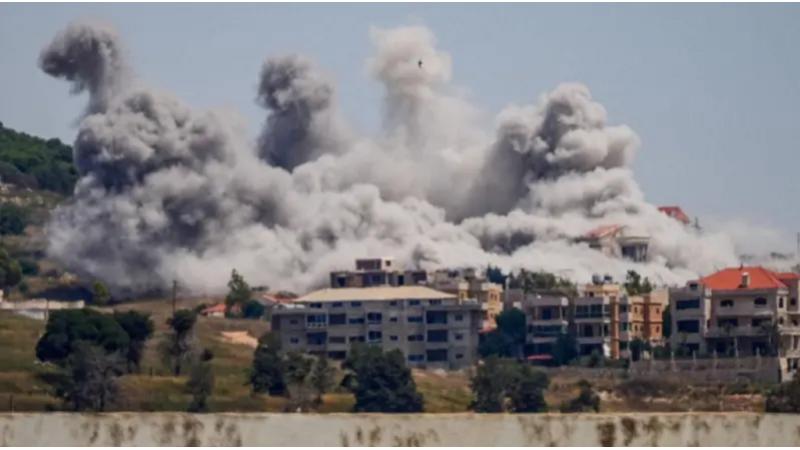
Jun 04, Kathmandu - Following high-level talks led by the United States in Washington, Israel and Lebanon have agreed to implement a ceasefire starting Wednesday. However, tensions remain high as Iran-backed Hezbollah has explicitly stated that no agreement will be enforced without a complete halt of exchanges of fire, casting uncertainty over the peace process.
Despite the absence of formal diplomatic relations, a joint statement revealed an agreement to establish a 'pilot zone' in the conflict area. Lebanese armed forces will assume control, removing non-state armed groups from the designated region.
Although the ceasefire was announced, clashes and attacks continued in border areas before and after the agreement. Hezbollah reportedly launched attacks targeting Israeli forces, with claims of at least 10 deaths in southern Lebanon due to Israeli strikes. Shortly after the announcement, Israel issued a warning for airstrikes following reports of suspicious aerial targets in northern Israel, although no casualties have been confirmed.
The joint statement stipulates that Hezbollah must fully cease fire and withdraw fighters from southern Lebanon for the ceasefire to hold. This marks the fourth phase of direct dialogue between Lebanese and Israeli representatives, which began on March 2 after Hezbollah resumed attacks on Israel with Iranian support.
Both sides also agreed to reconvene talks in the week of June 22, aiming to reach a comprehensive peace agreement.
Meanwhile, U.S. President Donald Trump emphasized that Lebanon's conflict and Iran-related tensions should be addressed separately. Iran, however, has linked these events, with Foreign Minister Abdollahian warning that any attack on Beirut could lead to a full-scale war resurgence.
Israeli forces reported intercepting hostile aircraft and projectiles from Lebanon on Wednesday. In response, Hezbollah claimed Israel violated the ceasefire by attacking northern Israel with rocket fire and launching two drone strikes near the Chaqif Castle military post.
Early Thursday, Hezbollah targeted Israeli soldiers and vehicles in Al-Kantara, southern Lebanon, and launched rockets, further escalating the conflict. The group also claimed to have carried out drone attacks near the same area.
The ceasefire, initially proposed for April 17, was repeatedly violated by both sides, with senior Hezbollah official Mahmud Khamati stating that the group would not accept a partial ceasefire.
Humanitarian tolls are rising. According to Lebanon’s state-run National News Agency (NNA), Israeli attacks targeted main roads outside the capital, with more than 20 locations attacked after Israel warned residents to evacuate southern villages. The Lebanese Health Ministry reports four Syrian and two Palestinian civilians were killed in attacks near Al-Hawas, although the Israeli military denied involvement in some incidents.
Ambulances and medical personnel have also been targeted, with at least six medics killed since the conflict began, including two paramedics from the Amal movement’s Rescue Scouts Association in Jibbin. The Ministry released images of damaged ambulances with scattered medical supplies.
Lebanese Armed Forces reported the death of one soldier and injuries to an officer and another soldier in separate incidents, condemning Israel’s targeted strikes on military sites and personnel.
As violence continues, the situation remains tense, with both sides cautious about fully implementing the ceasefire amid ongoing hostilities and humanitarian concerns.












 Indian Rupee
 U.S. Dollar
 European Euro
 UK Pound Sterling
 Swiss Franc
 Australian Dollar
 Canadian Dollar
 Singapore Dollar
 Japanese Yen
 Chinese Yuan
 Saudi Arabian Riyal
 Qatari Riyal
 Thai Baht
 UAE Dirham
 Malaysian Ringgit
 South Korean Won
 Swedish Kroner
 Danish Kroner
 Hong Kong Dollar
 Kuwaity Dinar
 Bahrain Dinar