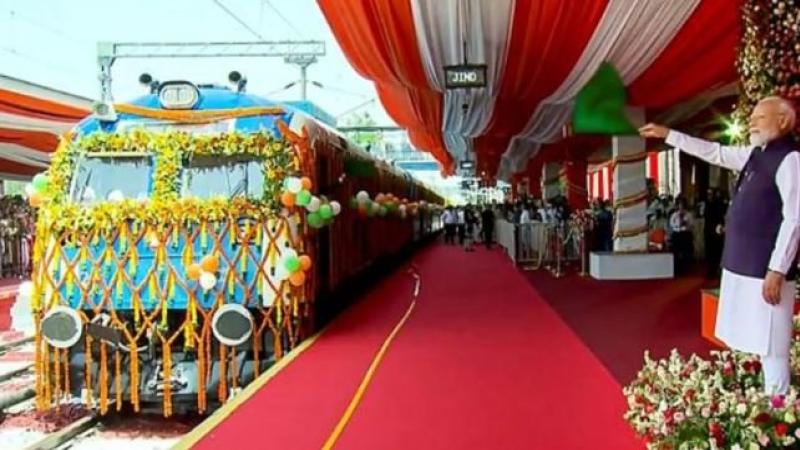
Jul 17, Kathmandu - Indian Prime Minister Narendra Modi inaugurated the country’s first and the world's longest hydrogen-powered train from Jind Railway Station in Haryana. This pioneering train marks a significant milestone in sustainable transportation and innovation.
The train, operating on the Jind–Sonepat route, is claimed by the Indian government to be the longest hydrogen-powered train in the world, comprising 10 carriages. It is designed to cover approximately 89 kilometers in around two hours, stopping at 12 stations along the way.
Addressing the inauguration ceremony, Prime Minister Modi highlighted that while other countries operate hydrogen trains with only three or four carriages, India has built a 10-carriage train with a capacity of 3,200 horsepower, establishing a new global benchmark.
He emphasized that this hydrogen train is not only emission-free but also a successful example of the ‘Make in India’ campaign. The train’s design was developed by Indian engineers and manufactured by an Indian company.
Modi pointed out the ongoing conflicts in West Asia and tensions in the Strait of Hormuz, noting that India imports a significant portion of its petroleum products, LPG, and fertilizers via maritime routes. Had India remained dependent on diesel trains like before 2014, disruptions in oil supplies could have led to severe crises.
He further shared that till 2014, only about 30% of India’s rail network was electrified. However, in the past 12 years, 99% of the rail routes have been electrified, including the complete electrification of Haryana’s railway network. This transformation has helped maintain uninterrupted rail services despite geopolitical tensions and fuel shortages.
On this occasion, Modi also inaugurated and laid the foundation stones for development projects worth approximately ₹14,700 crore. Key projects include the Delhi–Amritsar–Katra Expressway in Haryana, the Jind–Gohana National Highway, and the Ambala–Kala Amb four-lane highway, which are expected to significantly improve transportation connectivity in Haryana and Himachal Pradesh.







 Indian Rupee
 U.S. Dollar
 European Euro
 UK Pound Sterling
 Swiss Franc
 Australian Dollar
 Canadian Dollar
 Singapore Dollar
 Japanese Yen
 Chinese Yuan
 Saudi Arabian Riyal
 Qatari Riyal
 Thai Baht
 UAE Dirham
 Malaysian Ringgit
 South Korean Won
 Swedish Kroner
 Danish Kroner
 Hong Kong Dollar
 Kuwaity Dinar
 Bahrain Dinar