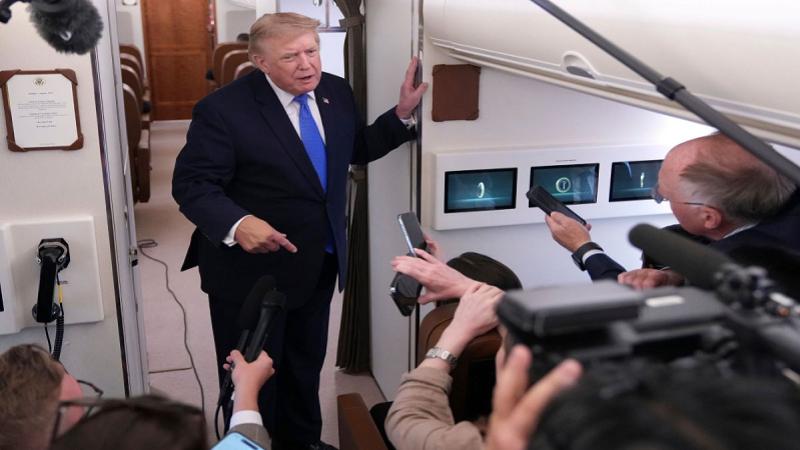
Aug 03, Kathmandu - U.S. President Donald Trump has announced that direct negotiations with Iran will commence starting tomorrow. Speaking to reporters aboard Air Force One while returning from his Gulf Club in New Jersey to Washington, Trump revealed that talks would begin on Monday afternoon, signaling a possible shift in U.S. Iran policy.
"They were preparing for an attack, so they knew the level of threat. Now, we are engaging in talks with them. The negotiations will start tomorrow afternoon, and we will see what happens afterward," Trump stated.
He further indicated that the planned U.S. military strike has been postponed at the final stage. "We were fully prepared for an attack, but at the request of our allies—Saudi Arabia, the UAE, Qatar, and Iran—we decided to hold off. They believe a peaceful resolution is possible," he added.
Trump expressed hope that initial discussions would focus on the Strait of Hormuz and Iran’s nuclear program. "First, there will be an agreement regarding the Strait of Hormuz, and then we can address Iran’s nuclear activities, which I have always emphasized should be permanently halted," he said.
According to Reuters, Saudi Prince Mohammed bin Salman reportedly spoke with Trump over the phone on Sunday, urging a halt to Iran-related military actions.
Despite warnings from the U.S., Iran has reportedly increased its provocative activities, including threats to attack energy infrastructure and bridges. The U.S. had prepared for a significant strike, but Iran had warned that any attack would target U.S. military bases, energy facilities, and Israeli energy infrastructure in the Middle East.
While Trump claims that the attack was halted at Iran's request, Tehran denies this assertion. Iranian sources suggest that Iran's weakened state is the reason for its refusal to escalate tensions further. Iran has also asserted that it is asserting control over the Strait of Hormuz, with plans to collaborate with Oman—although Oman has rejected such proposals.
The U.S. continues to push for free navigation through the Strait of Hormuz, amid ongoing disagreements over Iran’s nuclear program. Negotiations have yet to resolve issues surrounding Iran’s highly enriched uranium stockpiles, with the U.S. insisting Iran must halt its nuclear activities, and Iran refusing to agree to give up its enriched uranium or transfer it to the U.S.
This evolving diplomatic situation marks a critical moment in U.S.-Iran relations, with hopes for de-escalation amid ongoing regional tensions.
















 Indian Rupee
 U.S. Dollar
 European Euro
 UK Pound Sterling
 Swiss Franc
 Australian Dollar
 Canadian Dollar
 Singapore Dollar
 Japanese Yen
 Chinese Yuan
 Saudi Arabian Riyal
 Qatari Riyal
 Thai Baht
 UAE Dirham
 Malaysian Ringgit
 South Korean Won
 Swedish Kroner
 Danish Kroner
 Hong Kong Dollar
 Kuwaity Dinar
 Bahrain Dinar