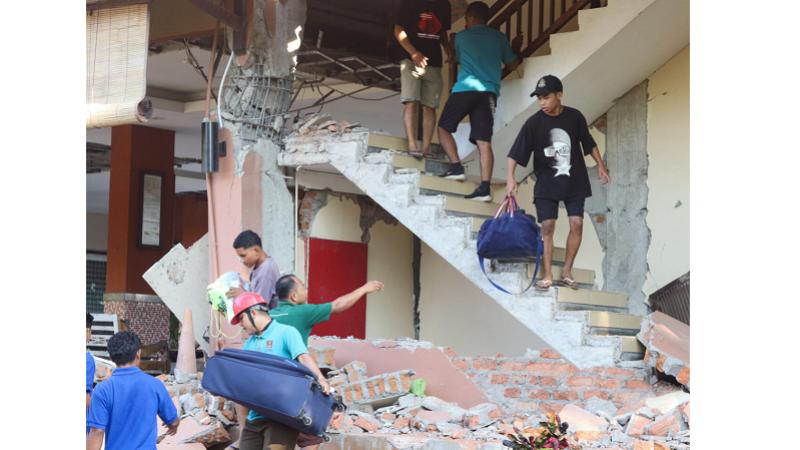
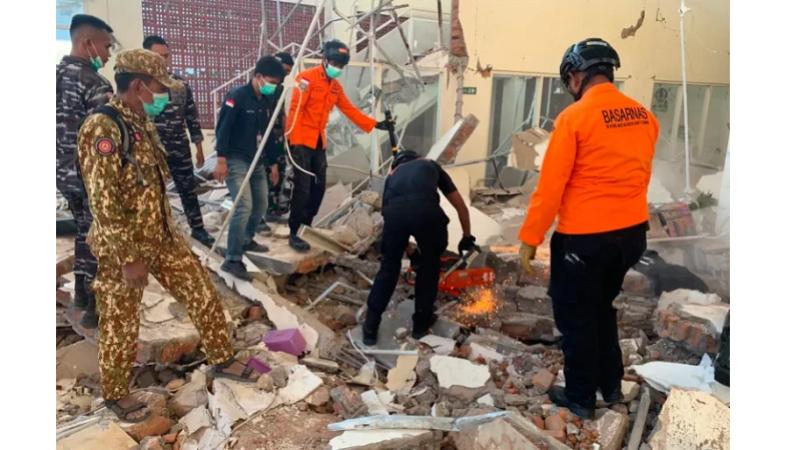
Aug 16, Kathmandu - A devastating 7.7 magnitude earthquake struck Indonesia’s Flores region on Saturday, drawing renewed global attention to the Pacific "Ring of Fire," a highly active tectonic zone prone to earthquakes and volcanic eruptions.
The quake occurred at approximately 5:58 AM local time, with its epicenter located about 68 kilometers northwest of Ende city in Nusa Tenggara, at a depth of around 10 kilometers, according to the United States Geological Survey (USGS).
Indonesian disaster management authorities reported at least 51 fatalities and numerous injuries resulting from the powerful tremor. Although a tsunami warning was initially issued for the eastern coast, it was later lifted as no significant threat materialized. However, small waves were recorded in some coastal areas, with Riung experiencing waves up to 1.61 meters.
In the aftermath, over 235 aftershocks have been recorded, the largest measuring 6.2 magnitude. Landslides and communication disruptions have hampered rescue efforts, with more than 150 homes completely destroyed and damage reported to schools, health facilities, and other public buildings. Approximately 2,000 residents have been relocated to temporary shelters.
Geologically, Indonesia is situated on the Ring of Fire—a vast zone encircling the Pacific Ocean where multiple tectonic plates converge. This region is the world’s most seismically and volcanically active, accounting for about 81% of the world’s major earthquakes.
Most earthquakes here are caused by subduction processes, where one tectonic plate slides beneath another, leading to frequent powerful quakes across South America, North America, and the western Pacific. The Flores area is no stranger to such disasters; a major earthquake and tsunami in 1992 claimed around 2,500 lives.
This recent quake follows a similar magnitude 7.4 earthquake in Colombia just days earlier, which was among the strongest of the century, resulting in over 280 deaths. Earlier in the month, Venezuela experienced two significant quakes measuring 7.2 and 7.5 magnitudes within seconds, causing extensive damage and over 5,000 casualties.
Experts note that these earthquakes are caused by different tectonic processes and are generally not directly connected, despite sometimes triggering minor tremors at distant locations.
The Ring of Fire extends from Japan, the Philippines, and New Zealand to Alaska and the western coasts of South America. Japan, situated at a complex converging plate zone, frequently experiences some of the most destructive earthquakes, including the 9.2 magnitude quake in Alaska in 1964—the second-largest ever recorded.
Earth’s outer shell is divided into moving tectonic plates, which continuously interact through collisions, subduction, and sliding past each other. These interactions generate immense stress and release energy in the form of powerful earthquakes, often accompanied by volcanic activity, perpetuating this geological cycle.














 Indian Rupee
 U.S. Dollar
 European Euro
 UK Pound Sterling
 Swiss Franc
 Australian Dollar
 Canadian Dollar
 Singapore Dollar
 Japanese Yen
 Chinese Yuan
 Saudi Arabian Riyal
 Qatari Riyal
 Thai Baht
 UAE Dirham
 Malaysian Ringgit
 South Korean Won
 Swedish Kroner
 Danish Kroner
 Hong Kong Dollar
 Kuwaity Dinar
 Bahrain Dinar