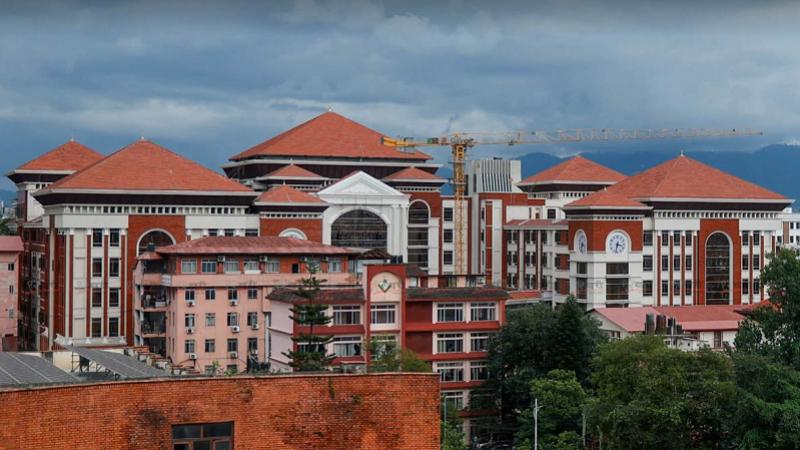
Aug 24, Kathmandu - The high-level study committee formed by the Supreme Court to improve judicial administration is finalizing a comprehensive report with recommendations.
Chief Justice Dr. Manoj Kumar Sharma has established a committee led by Justice Tek Prasad Dungana, with Supreme Court Justices Sunil Kumar Pokhrel and Nrip Dwij Niraula as members. The committee also includes judges from the higher and district courts, along with senior administrative officials from the Supreme Court.
"We have gathered suggestions from judges, court staff, legal practitioners, bar associations, and government lawyers across all sectors. We are in the final stages of completing the report," said Sri Lal Poudel, the Registrar of the Supreme Court and a member of the committee. "We plan to submit the finalized report within this week."
The committee also collected opinions through Google Forms to ensure broader input. Justice Dungana’s leadership was commissioned by Chief Justice Dr. Sharma immediately after his appointment on June 20. Once the report is finalized, it will be presented to the Chief Justice.
"After the Supreme Court full bench approves and passes the report, the implementation process will be initiated," Poudel explained.
The report is expected to cover key areas such as revising the jurisdiction of courts, improving case and hearing management, restructuring specialized courts, and recommending legal reforms to make the judiciary faster, more transparent, and effective.
This report is anticipated to serve as a guiding document for structural reforms within the judiciary. Historically, various committees and task forces have been established to address judicial issues, including a committee formed in 1966 under then-Supreme Court Justice Ram Prasad Shrestha to identify and rectify irregularities and delays.
Earlier efforts include a 1964 committee led by Senior Advocate Shreehari Aryal aimed at restoring public confidence in the judiciary by eliminating irregularities and ensuring transparent appointment processes. Additionally, committees led by Justice G.P. Shankar Lal and others have focused on judicial conduct and reforms.
Even during the Panchayat era, a ‘Royal Commission’ was formed in 1928 to reform the judiciary. Similar commissions were established in 1940 and after the 2006 political changes, highlighting ongoing efforts to improve judicial integrity and efficiency.
In the wake of recent movements like the ‘Gangi’ movement, which exposed irregularities and structural issues within the judiciary, the formation of this high-level committee signifies a renewed push towards comprehensive judicial reforms.








 Indian Rupee
 U.S. Dollar
 European Euro
 UK Pound Sterling
 Swiss Franc
 Australian Dollar
 Canadian Dollar
 Singapore Dollar
 Japanese Yen
 Chinese Yuan
 Saudi Arabian Riyal
 Qatari Riyal
 Thai Baht
 UAE Dirham
 Malaysian Ringgit
 South Korean Won
 Swedish Kroner
 Danish Kroner
 Hong Kong Dollar
 Kuwaity Dinar
 Bahrain Dinar