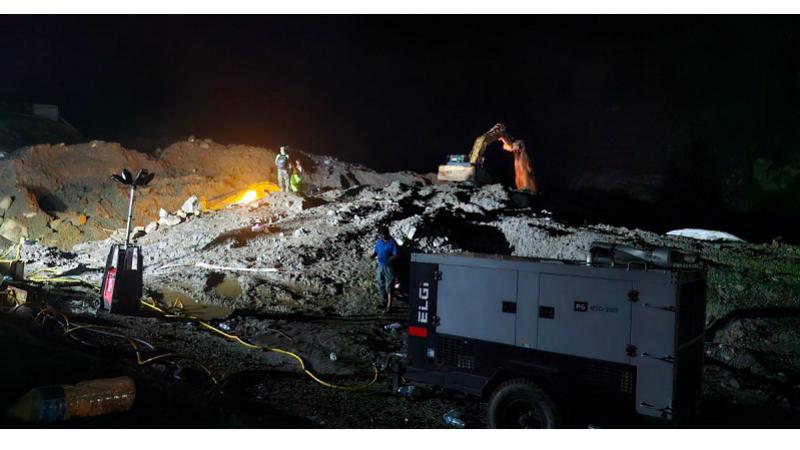
Aug 31, Kathmandu - Rescue efforts continue to face significant challenges at the upper Trishuli-3 'A' Hydropower Project site, which was submerged due to flooding caused by the Bhote Koshi-Trishuli river breach. Authorities estimate that between 35 and 40 workers and staff remain trapped inside the project’s tunnel.
For the past five days, a team comprising the Nepal Army and experts has been working tirelessly to rescue the stranded individuals. While the team has identified the tunnel’s entrance, they have yet to reach the trapped personnel inside due to severe flooding and debris.
Rescue operations have been ongoing overnight, with continuous excavation efforts. According to Sri Ram Naupane, a member of parliament and tunnel expert leading the rescue team on the ground, the tunnel’s crown was blasted around 3 a.m. tonight. However, water-filled conditions inside the crown made entry impossible.
"If there had been no water inside, we could have reached the trapped persons by now. But due to the water, entry is impossible. We are working on an alternative approach," Naupane told Setopati.
Efforts are currently focused on removing water, mud, and debris from inside the tunnel. The tunnel measures approximately 40 meters in width and height, filled with rocks, mud, and debris. The existing machinery is old and limited, making it difficult to bring in new equipment. The team is also conducting blasting to drain water from the tunnel.
Social media has shown scenes of workers using crowbars to remove mud and debris from the tunnel entrance. Naupane explained that only the available resources are being used at present.
"We need two large excavators, but they cannot be transported by helicopter. Even if we bring parts and assemble them here, it will take several days. For now, we are working with whatever equipment is available," he said.
Additional efforts include pumping out water from inside the tunnel. However, Naupane expressed concern that, given the current pace of work, reaching the trapped individuals may remain difficult for the rest of the day.





 Indian Rupee
 U.S. Dollar
 European Euro
 UK Pound Sterling
 Swiss Franc
 Australian Dollar
 Canadian Dollar
 Singapore Dollar
 Japanese Yen
 Chinese Yuan
 Saudi Arabian Riyal
 Qatari Riyal
 Thai Baht
 UAE Dirham
 Malaysian Ringgit
 South Korean Won
 Swedish Kroner
 Danish Kroner
 Hong Kong Dollar
 Kuwaity Dinar
 Bahrain Dinar