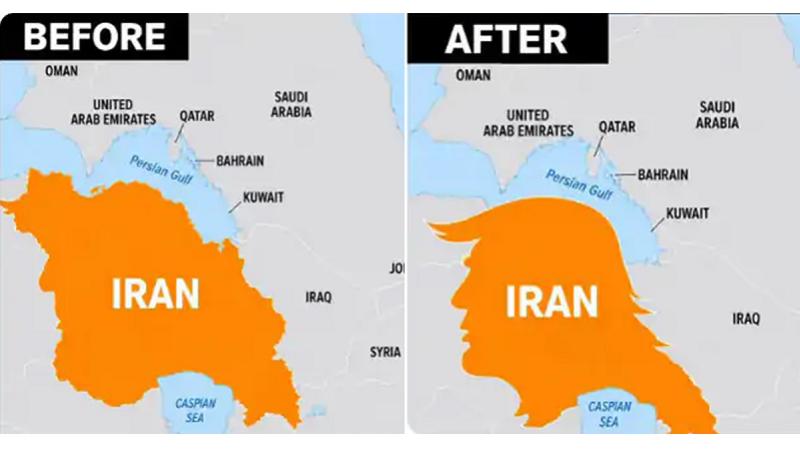
Sep 07, Kathmandu - In a swift series of seven strategic and provocative posts within an hour, U.S. President Donald Trump has intensified his rhetoric against Iran on social media. The posts come amid escalating tensions between the two nations, focusing on Iran's struggling economy and strategic vulnerabilities.
Trump’s posts highlight Iran’s collapsing economy, declining oil exports, soaring inflation, and a weakened national currency, the Rial. He has targeted Iran’s economic stability with a series of graphics and statements designed to put pressure on Tehran.
Key Highlights of Trump’s Posts:
- He shared a graphic modifying Iran’s geographical map into a shape resembling his own face.
- A second graphic depicted Iran’s currency, the Rial, with a bold caption declaring its collapse.
- In another post, Trump claimed Iran's economy is in free fall, citing data that the value of the Rial has plummeted from 900,000 to over 2.27 million against the US dollar since 2025.
- He presented a graphic suggesting that global oil supply through the Strait of Hormuz is returning to normalcy.
- A further post showed Iran’s oil exports dropping from 2 million barrels daily in early 2025 to nearly zero by 2026.
- Trump also shared a graphic exposing Iran’s economic crisis with soaring prices.
- In a highly aggressive move, he posted an AI-generated image of American warplanes bombing the key oil export hub, Kharg Island, with a caption saying “Bye bye, Kharg,” emphasizing its strategic importance.
The final post features a map of Iran, claiming the country is becoming a failed state, with the government unable to manage the deteriorating situation. These social media blitzes follow Iran’s recent announcement of new restrictions in the Hormuz Strait and a map agreement with Oman—moves that have further heightened U.S.-Iran tensions.
Analysts suggest that Trump’s barrage of provocative posts signals a significant escalation in the ongoing conflict, with the potential to impact regional stability and international oil markets.
















 Indian Rupee
 U.S. Dollar
 European Euro
 UK Pound Sterling
 Swiss Franc
 Australian Dollar
 Canadian Dollar
 Singapore Dollar
 Japanese Yen
 Chinese Yuan
 Saudi Arabian Riyal
 Qatari Riyal
 Thai Baht
 UAE Dirham
 Malaysian Ringgit
 South Korean Won
 Swedish Kroner
 Danish Kroner
 Hong Kong Dollar
 Kuwaity Dinar
 Bahrain Dinar