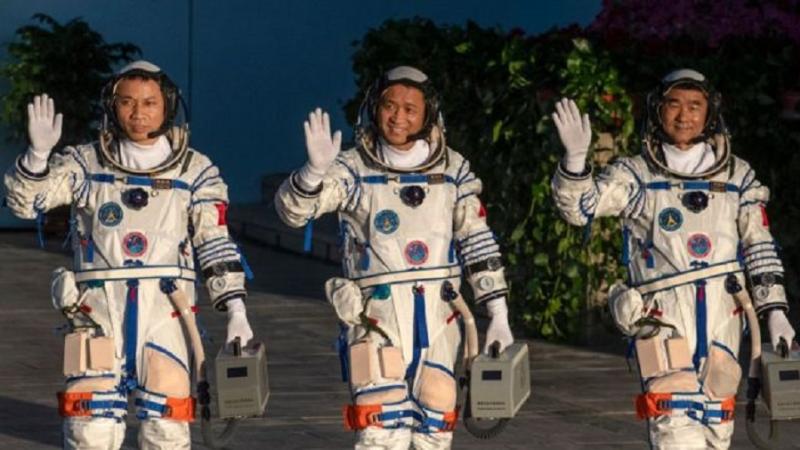
Sep 21, Kathmandu - China has successfully cultivated more than 20 types of plants across 14 species on its Tiangong space station, marking a significant milestone in extraterrestrial agriculture. Chinese officials have stated that this achievement lays a solid foundation for large-scale crop production in space in the future.
According to the China Astronaut Center, a variety of crops including lettuce leaves, carrots, sunflowers, potatoes, and wheat are currently being grown aboard the station. Recently, at the Space Medicine and Engineering Conference held in Tianjin, northern China, astronaut Zhang Hongzhang shared images and videos showcasing the plants thriving in space.
China's long-term human spaceflight era began in October 2021, when astronauts Zhai Zhigang, Wang Yaping, and Ye Guangfu entered the core module ‘Tianhe’ of the Chinese space station aboard Shenzhou 13.
Bian Qiang, a scientist at the China Astronaut Center, emphasized the importance of reducing reliance on Earth for supplies such as food, water, and other essentials during prolonged space habitation. To achieve this, China is developing a controlled ecological life-support system, which involves artificially creating a closed environment where air, water, and food are recycled and produced locally. The ultimate goal is to produce necessary life-supporting resources directly in space for long-term human presence.
Currently, two systems are operational for growing plants on the station. One uses specialized media for plant cultivation, while the other employs an air-based technology that supplies nutrients to plant roots through water or nutrient-rich solutions in the air. These experiments are providing crucial experience in space-based plant cultivation and food production, paving the way for sustainable life-support systems for future long-duration missions.
In 2025, China launched an improved air-based plant production system into space. Since then, wheat has completed its full growth cycle in space, and the second round of wheat planting, using seeds from the first harvest, is also thriving and nearing harvest, according to Bian.
The successful completion of the wheat growth cycle in space is considered a major achievement for China, as it reduces dependence on Earth for importing seeds and food. This development offers new insights into sustainable resource management for extended space missions.
Looking ahead, China plans to establish a vegetable garden on the Moon as part of its lunar exploration program. If successful, this could enable astronauts on the Moon to produce fresh food locally, supporting longer stays.
The Tianong space station, whose name means ‘Heavenly Palace,’ has now entered a phase of long-term human habitation. During the Shenzhou 23 mission, an astronaut plans to stay in space for up to a year.
Furthermore, China aims to land humans on the Moon by 2030, advancing its lunar exploration program. The ongoing experiments in space-based crop production are expected to play a crucial role in future lunar and deep-space missions by providing vital food resources and life-support systems for astronauts.













 Indian Rupee
 U.S. Dollar
 European Euro
 UK Pound Sterling
 Swiss Franc
 Australian Dollar
 Canadian Dollar
 Singapore Dollar
 Japanese Yen
 Chinese Yuan
 Saudi Arabian Riyal
 Qatari Riyal
 Thai Baht
 UAE Dirham
 Malaysian Ringgit
 South Korean Won
 Swedish Kroner
 Danish Kroner
 Hong Kong Dollar
 Kuwaity Dinar
 Bahrain Dinar