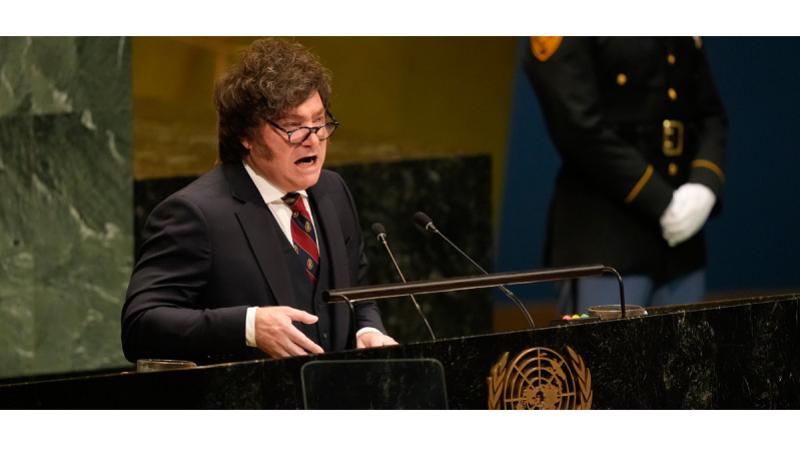
Sep 24, Kathmandu - Argentine President Javier Milei has reiterated his country's claim of sovereignty over the islands, known locally as Malvinas, and called for renewed negotiations to resolve the conflict peacefully.
Addressing the United Nations General Assembly, Milei emphasized that the Falklands remain a national issue for Argentina. He criticized the international community for failing to implement resolutions aimed at resolving the dispute and accused the UN of not taking sufficient steps toward a peaceful solution.
Milei urged the United Kingdom to return to the negotiation table and settle the sovereignty issue through dialogue. He pointed out that the Falkland Islands dispute is not only a bilateral issue between Argentina and the UK but also a test of the UN's ability to enforce its own resolutions.
The Argentine leader also criticized the United Nations' role, alleging that it has not taken enough initiative in mediating the conflict. Recently, the dispute has intensified with reports of offshore oil exploration near the islands, with Argentina imposing sanctions on over 60 companies and individuals involved in such activities.
Furthermore, Argentina's parliament recently introduced legislation to crack down on natural resource exploitation without government approval. Meanwhile, British Prime Minister Andy Burnham expressed support for the right of Falkland Islanders to self-determination and reaffirmed the UK's right to remain in control of the islands.
Following a meeting with U.S. President Donald Trump on Tuesday, Burnham stated that Britain would remain steadfast in facing any threats. The Falkland Islands, located about 480 kilometers east of Argentina in the South Atlantic, have a population of around 3,500 residents and have been under British control since 1833, despite Argentina's continuous claims.
The conflict escalated in 1982 when Argentina, under military rule, invaded the islands, leading to a 73-day war that resulted in the deaths of 649 Argentine and 255 British soldiers. The islands remain a symbol of national sovereignty for Argentina, with a 2013 referendum showing most residents favoring continued British administration.















 Indian Rupee
 U.S. Dollar
 European Euro
 UK Pound Sterling
 Swiss Franc
 Australian Dollar
 Canadian Dollar
 Singapore Dollar
 Japanese Yen
 Chinese Yuan
 Saudi Arabian Riyal
 Qatari Riyal
 Thai Baht
 UAE Dirham
 Malaysian Ringgit
 South Korean Won
 Swedish Kroner
 Danish Kroner
 Hong Kong Dollar
 Kuwaity Dinar
 Bahrain Dinar