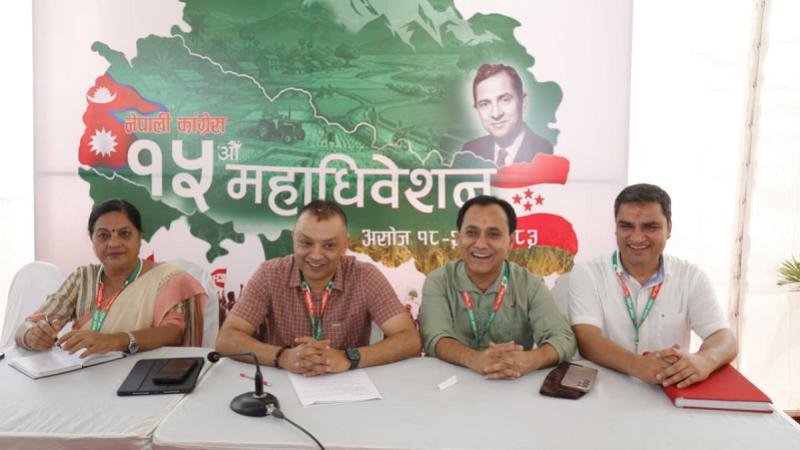
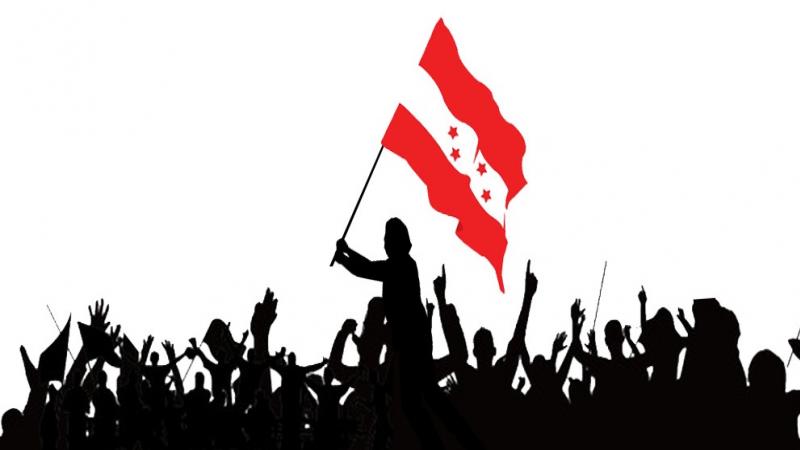
Oct 05, Kathmandu - The Nepali Congress Central Working Committee has approved a political report prepared by party president Gagan Kumar Thapa for presentation at the party’s 15th General Convention.
The report sets out the party’s political, ideological, organisational and economic direction for the next four years. It covers a review of the party’s past, its role in holding the government accountable, a policy against pre-election alliances, party restructuring, cooperation with the private sector and greater youth participation—all under the vision of a “Prosperous Nepal, Respected Nepalese.”
Thapa’s report acknowledges that, over the past two decades, the party prioritised positions and power over its core objectives. It says coalition management, power-sharing, factionalism and transactional politics weakened the party’s moral standing. The report also criticises the tendency to shield party members accused of corruption and irregularities, saying it undermined the independence of public institutions.
The document recognises that the party has grown distant from younger generations and failed to keep pace with changing public expectations. It says the party apologised to the public at its second special convention and pledged to reform.
Among its proposals are a new policy on elections and alliances, ideological renewal, and a stronger opposition role. It also calls for a system that enables citizens to scrutinise major government and public decisions, including through a digital platform showing budget spending and the details of officials responsible.
The report addresses the economy and private sector, jobs, migration and population, agriculture, industry and production, climate change and green development, technology and artificial intelligence, federalism, transitional justice and national sovereignty. It also proposes organisational reforms, stronger internal discipline and anti-corruption measures, election reforms, a two-term limit for prime ministers, and special support for youth, martyrs, injured people and displaced communities.












 Indian Rupee
 U.S. Dollar
 European Euro
 UK Pound Sterling
 Swiss Franc
 Australian Dollar
 Canadian Dollar
 Singapore Dollar
 Japanese Yen
 Chinese Yuan
 Saudi Arabian Riyal
 Qatari Riyal
 Thai Baht
 UAE Dirham
 Malaysian Ringgit
 South Korean Won
 Swedish Kroner
 Danish Kroner
 Hong Kong Dollar
 Kuwaity Dinar
 Bahrain Dinar