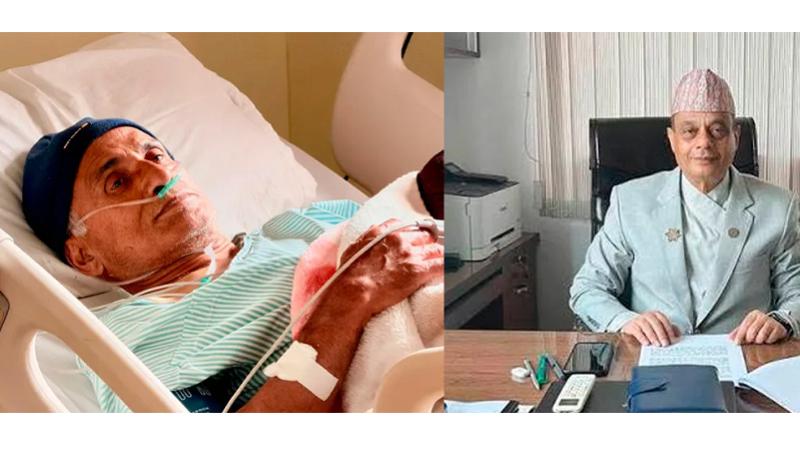
Nov 02, Kathmandu - Nepal’s Medical Education Commission is facing questions over its impartiality after allegations that Vice-Chair Prof. Dr. Devendra Bahadur Khatri used his position to place his wife in a role connected to determining medical college seats.
The controversy arose after a member of Khatri’s family was reportedly brought in as an expert and assigned to a sensitive seat-allocation committee. Critics say the arrangement raises concerns about institutional good governance and a potential conflict of interest.
Dr. Govinda KC has strongly objected to Khatri’s appointment and recent decisions. KC pointed to Khatri’s previous role as principal of Nepal Army Medical College and the subsequent increase in seats at the institution, saying the sequence raises questions about possible conflicts of interest.
The Commission has allocated 9,691 seats across educational institutions for the current academic year, an increase of 418 overall. Shahid Dasharath Chand University of Health Sciences received 50 MBBS seats, while B.P. Koirala Institute of Health Sciences and the Nepalese Army Institute of Health Sciences each received an additional 30 seats.
Seat allocations are proposed based on inspection reports prepared by expert teams. The Commission’s Planning Directorate is responsible for the process, but its Planning, Coordination and Academic Advancement Directorate currently has no appointed head. Dr. Sandhya Chapagain has been given interim responsibility.
Khatri has denied the allegations and called for an investigation. Speaking to Ratopati, he said he had not invited or appointed any family member, adding that the Commission relies on hundreds of experts amid a shortage of personnel. He described the claims as baseless and said that even if a family member served as an expert, it was not at his request.










 Indian Rupee
 U.S. Dollar
 European Euro
 UK Pound Sterling
 Swiss Franc
 Australian Dollar
 Canadian Dollar
 Singapore Dollar
 Japanese Yen
 Chinese Yuan
 Saudi Arabian Riyal
 Qatari Riyal
 Thai Baht
 UAE Dirham
 Malaysian Ringgit
 South Korean Won
 Swedish Kroner
 Danish Kroner
 Hong Kong Dollar
 Kuwaity Dinar
 Bahrain Dinar